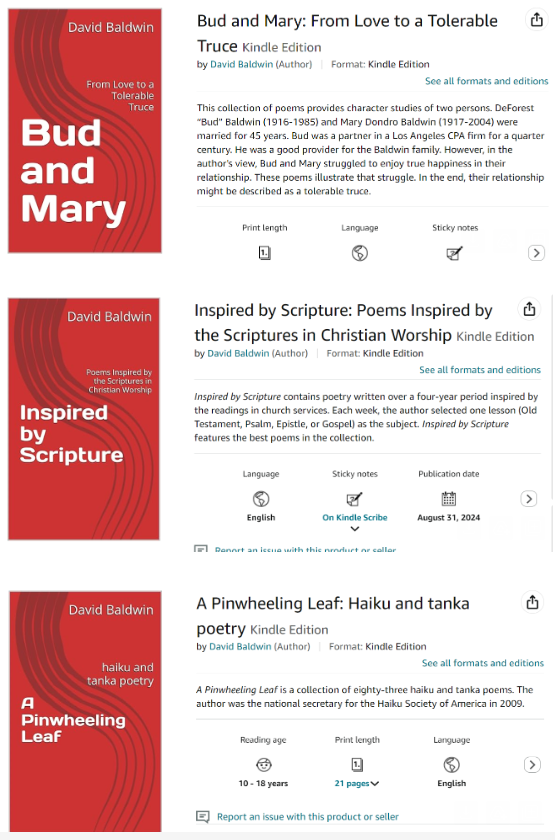
I uploaded three of my poetry eBooks to Amazon this week. Go to Amazon.com and select Books. In the search engine, do this: (a) Type “Bud and Mary Baldwin”, (b) Type “Inspired by Scripture Baldwin”, or (c) Type “A Pinwheeling Leaf Baldwin”
The word of the Lord is an oscillating dialog of course-corrections from the officer of the deck to the helmsman as the helmsman utters “Aye,” repeats the command, and turns the helm and tiller to the new heading.
Except the word is a quiet voice within and not a person bellowing over the main. Brothers and sisters, it connects God with man— a constant conversation for those who choose to listen.
Cigars evoke the stadium. Whenever I catch the drift of a great cigar,
I revisit the Coliseum where you and I would cheer the darkest team In white America. The tunnels reeked of smoke, cigars especially; today I miss the stench.
Cigars evoke for me our best of times as father and son. Whatever I meant to you and you to me in real life, together we loved the game.
As I stooped through the low portal of death, I saw my human fate emptied out into a lethe.
Life’s luggage of love and hate was left behind the wall; the gardener burned my once-essential freight.
I asked myself if this was all. Intelligent souls clicked like dolphins in the wind on either side of the wall,
discerning everything. My mind came clean; discernment whirled ahead as soon as I was schooled by the garrulous wind.
Now that I am dead, I know that God did not create the soul; the soul created God instead.
Now that I am dead, I know the soul imagined heaven straddling earth where God was hired to rule
irascible man and iterative death/rebirth. I dreamed of an infinite life, a dream encoded before my birth,
because one life was not enough. I know that paradise was once inside my head, now that I am dead.
NOTE: I read “Evening Land” and wrote this poem over 30 years ago. It was published in 2018. We wrote book reports when we were in school. “Now That I Am Dead” is like that. There is a poignant tone of regret throughout about Lagerkvist’s loss of faith. I tried to capture his point of view here.
The flowing lake is always filling, but is never full. Once there was a true sense of fullness— of which all that now remains is an empty print and trace. The lake strains for completion with waters around it— seeking in things that are not there the help it cannot find in those things that are. Instead, there is a chronic ache that comes from feeling incomplete.
Sometimes on my morning run, I hear the call and response of two owls. They move around, never in the same place twice, but I know who they are because the smaller of the two is one white note higher on the keyboard, and each has a pitch always the same. No one owl initiates the call every time. They take turns. The 2-hoot call is followed by a two-Mississippi wait for the 2-hoot response, then they take 15 seconds to think about it before the next exchange. I imagine both are saying the same thing: “I am yours. I am here for you.”
With a plumb-line, the wall of Israel was erected with closely-fitted, well-joined stones. These perpendicular stones were the very bones of a great nation, but a careless people neglected their promise to the Lord. They failed to stay the ruin. And now the Lord is holding a line and plummet against the wall. It is used for building up; the line is also used for tearing down as the demolition crew decides how much to raze. The Lord bears long, but the Lord won’t bear forever. The herdsman Amos foretells the coming days of desolation for an errant nation who lost its way. The bowing, bulging wall is put to the measure; by the sword of justice, the edifice is swept away.